Apportionment and Pre-Existing Conditions in Workers' Comp
 April 11, 2026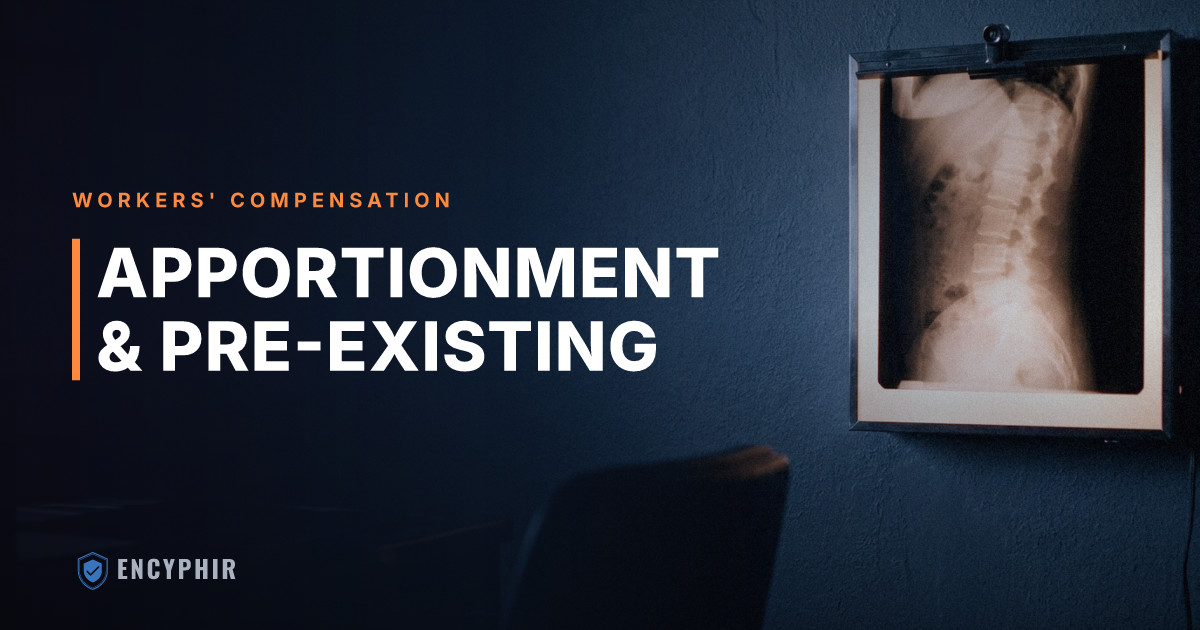
Pre-existing conditions don't defeat workers' compensability, but they almost always shape it. Apportionment determines what share of the claimant's current disability comes from the work injury versus pre-existing or non-industrial causes. It is a central issue in every meaningful workers' comp case, and investigation plays a significant role in developing the apportionment picture.
What Apportionment Is
Apportionment is the legal doctrine that divides responsibility for permanent disability among causative factors. In workers' comp, typical apportionment factors include:
- Pre-existing medical conditions
- Prior injuries (industrial or non-industrial)
- Subsequent non-industrial injuries
- Natural progression of a condition
- Aging-related degenerative changes
The specific apportionment framework varies by state. California's statutory framework (Labor Code 4663 and 4664) is particularly detailed. Other states apply common-law or different statutory frameworks.
The Rule of Aggravation
Workers' comp covers aggravations of pre-existing conditions, not just "pure" new injuries. A worker with a pre-existing back condition who is injured at work and experiences a new disability can recover for the aggravation. The benefit may be apportioned to reflect the pre-existing component.
Why Pre-Existing Condition Investigation Matters
Apportionment is a significant driver of claim valuation. A permanent disability rated at 50% that is apportioned 50% to pre-existing causes and 50% to the work injury produces meaningfully lower indemnity than the same disability attributed entirely to the work injury. Over a long-tail claim, the apportionment finding can move claim value by six figures.
What Investigation Contributes
Medical providers rely on the medical records and history given to them. If that history is incomplete, the apportionment determination is incomplete. Investigation supports apportionment by surfacing:
- Prior injuries the claimant may not have disclosed
- Prior providers the claimant did not list
- Prior treatment records from sources unrelated to the current claim
- Non-industrial injury history
- Age-related or natural progression context
Prior Claims Research
The starting point: prior workers' comp claims history through ISO ClaimSearch, supplemented by direct research at state workers' comp agencies. Prior claims on the same body part are particularly relevant.
Medical Canvass
Medical canvass means contacting prior providers to request records on the claimed body part. It is a standard apportionment tool. The process:
- HIPAA authorization obtained (claimant signs, provides authorization for medical record release)
- Investigator identifies providers through prior claims records, ISO ClaimSearch, CLUE, and claimant statement
- Record requests sent to each provider
- Records reviewed for relevance to the claimed condition
Medical canvass typically surfaces additional providers the claimant did not list. That alone is often dispositive.
Prior Auto and Other Injury Claims
Non-industrial injury history shapes apportionment. This includes:
- Auto accidents
- Premises liability
- Sports injuries
CLUE data, court records, and claimant background research surface this history.
Social Media and Physical History
Social media posts over years can reveal prior injuries, surgeries, rehabilitation, or physical limitations that preceded the current work injury. See our social media investigation post.
Employment History and Prior Occupations
For cumulative trauma and repetitive-motion claims, prior occupations are significant. Decades of heavy lifting in a prior job may shape apportionment on a current injury. Employment history research is part of the apportionment picture, including:
- Prior employers
- Prior positions
- Duration in physical roles
Prescription History
Prescription monitoring program (PMP) queries and pharmacy canvass can surface prior pain management, orthopedic treatment, or other prescription history relevant to the condition. Permissible-purpose and state-law rules govern access.
IME / QME Coordination
Independent medical examinations and qualified medical evaluations depend heavily on the history the evaluator has access to. Investigation can support IME/QME by providing:
- Compiled prior-claims history
- Medical canvass findings
- Social media findings relevant to physical history
- Surveillance of current activity
An IME with a full prior-history packet reaches a different conclusion than one without.
Apportionment Reports
A well-developed apportionment investigation produces:
- Chronology of prior injuries, treatment, and claims
- Documentation of providers and records obtained
- Gaps identified (providers not reached, records unavailable)
- Summary of findings directly relevant to apportionment analysis
- Exhibit index with records, authorizations, and research outputs
The Defense Counsel Relationship
Apportionment investigation is typically run in coordination with defense counsel. Counsel identifies the specific apportionment hypothesis. Investigation develops the evidence. The medical evaluator interprets the evidence. The three-part collaboration usually produces the strongest apportionment outcome.
Ethics
Medical canvass and prior-record research operate under HIPAA, permissible-purpose rules, and state privacy law. Investigations that cut ethical corners create issues the defense team will face downstream. Our FCRA and GLBA compliance post covers the permissible-purpose framework.
Common Apportionment Scenarios
Certain fact patterns recur in apportionment work, and recognizing them early shapes how investigation is scoped. The aging laborer with accumulated wear-and-tear presents a common pattern. A claimant in their late fifties or early sixties with a lifetime of physical work reports a specific industrial injury, but imaging reveals multi-level degenerative changes that long predate the claimed event. Prior employer records, prior primary care visits documenting intermittent pain complaints, and occupational history research all help distinguish the acute industrial component from the degenerative baseline.
A second recurring pattern involves the claimant with a prior motor vehicle accident settled years earlier. The settlement file, if obtainable through discovery or CLUE records, often contains diagnostic imaging and treatment notes identifying the exact body parts now at issue. A third pattern: the claimant with a prior workers' comp claim at a different employer, sometimes in a different state, that went unreported on the current claim forms. Multi-state claims research is essential here. Our AOE/COE and workers' compensation investigations team routinely works across jurisdictions to surface these prior filings.
Athletes and former athletes present a fourth pattern worth flagging. High school and college athletic injuries frequently appear in team medical records, trainers' notes, or local news archives. These often involve knees, shoulders, and the spine. Recreational activity injuries documented on social media over a decade or more can also recontextualize a claim.
Surveillance as Apportionment Evidence
Surveillance contributes to apportionment in a way that is often underappreciated. A claimant who describes current limitations as entirely the result of the work injury, but who is observed performing activities consistent with a pre-existing condition profile, gives the medical evaluator reconcilable or irreconcilable data. The question for the evaluator is not only "what can the claimant do?" but also "is the current functional picture consistent with the described mechanism of injury, or more consistent with a longer-standing degenerative process?"
Activity checks at home, at recreation sites, and in the context of secondary employment all inform that analysis. Targeted surveillance and activity checks coordinated with the apportionment theory produce the most usable footage. Generic observation does not. Coordinating surveillance timing with IME dates and medical appointments also tends to produce the clearest contrasts between reported and observed function.
Building the Pre-Injury Baseline
The strongest apportionment files establish a clear pre-injury baseline: what this specific claimant's functional and medical status looked like in the months and years before the claimed date of injury. Baseline evidence is assembled from several sources:
- Primary care records
- Employer physical examination files
- DOT medical cards for commercial drivers
- Fitness-for-duty evaluations
- Union medical records where applicable
- Gym or personal training records where they exist
Pre-injury imaging is particularly valuable. An MRI or X-ray taken two years before the claimed injury that shows disc desiccation, facet arthropathy, or rotator cuff tendinopathy gives the medical evaluator objective baseline data. Without that comparison point, post-injury imaging is often read as "consistent with trauma" when it may equally reflect pre-existing degeneration. Broader insurance background and asset investigations work often turns up baseline records that the claim file alone does not contain.
Cross-Jurisdictional Considerations
Claimants move between states, work for employers headquartered elsewhere, and receive treatment across state lines. An apportionment investigation that stops at the state border misses substantial history. Workers' comp agencies in neighboring states, out-of-state court records, and regional hospital systems all warrant coverage when the claimant's history suggests prior residence or employment elsewhere. For carriers and law firm clients handling multi-state programs, our law firm client services are structured to coordinate this kind of multi-jurisdiction research under a single case file.
Language and cultural factors also matter. Claimants who received earlier treatment in another country, or who mainly use providers within a specific community network, may have a medical history that is invisible to standard domestic canvass. Engaging investigators who can work through those channels ethically and with proper authorization produces a more complete picture.
Timing and Cost Discipline
Apportionment investigation yields the strongest return when scoped early. The cost of a medical canvass, prior claims pull, and employment history build-out is modest relative to the indemnity exposure on a disputed permanent disability rating. Waiting until shortly before the QME or trial date compresses timelines, forces rushed record requests, and often leaves gaps that opposing counsel will exploit.
A disciplined intake process, clear apportionment hypotheses from counsel, and staged investigation (prior claims first, then canvass, then surveillance and IME support) keeps spend proportionate to claim exposure. Clients ready to discuss a specific file or program-level approach can reach the team through our contact page.
Our Services
Our AOE/COE and workers' compensation services include full apportionment investigation support for carriers, TPAs, self-insured employers, and defense counsel. This covers prior claims research, medical canvass, employment history, and IME coordination.
This post is general information about apportionment frameworks. Specific cases require counsel familiar with the applicable state law.