How Investigators Catch Staged Accidents: Inside the Techniques That Expose Fraud
 October 17, 2026
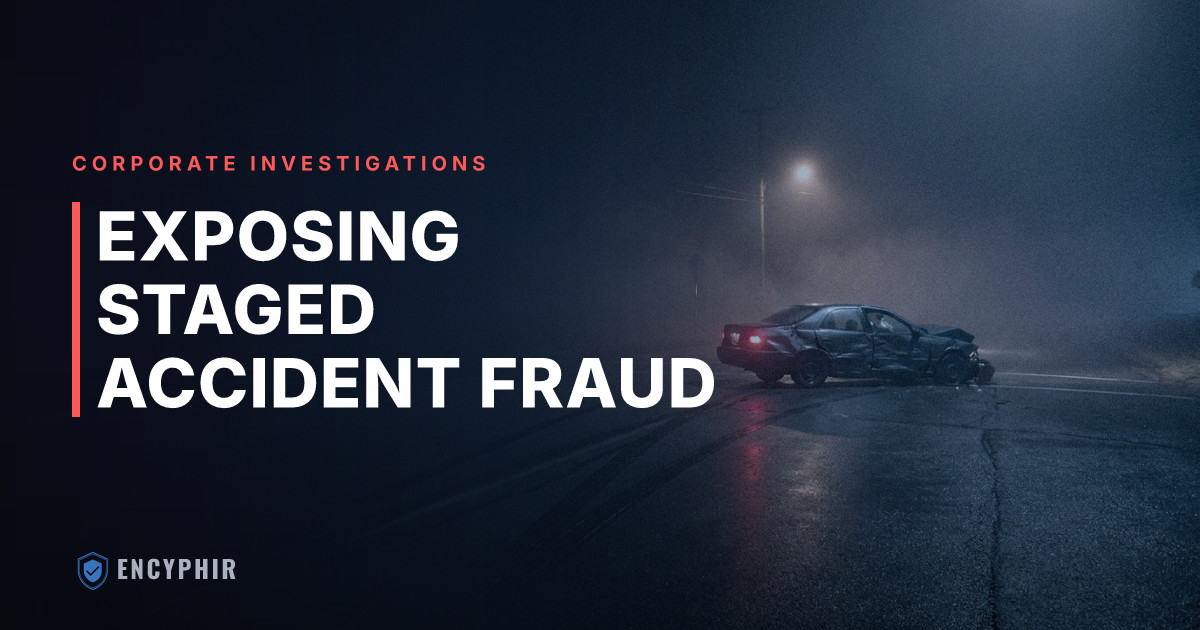
Staged accidents cost insurers, employers, and businesses billions of dollars every year. Whether it's a suspicious slip-and-fall in a retail store, a rear-end collision involving a company vehicle, or a workers' compensation claim that doesn't quite add up, fraudulent accident claims are more common, and more sophisticated, than most business owners realize. The good news is that professional investigators have developed a wide range of proven techniques to expose these schemes before they drain corporate resources or damage reputations.
At Encyphir Risk Management, we've seen how quickly a well-organized investigation can dismantle even the most carefully rehearsed fraud. Understanding how investigators catch staged accidents can help business leaders recognize warning signs, protect their organizations, and know when to bring in professional help.
Recognizing the Red Flags of a Staged Accident
Experienced investigators know that staged accidents rarely look identical to legitimate ones. There are patterns, and once you know what to look for, the inconsistencies begin to stand out. Common red flags include:
- Claimants who report injuries disproportionate to the damage on the vehicle or property
- Multiple passengers all reporting identical soft-tissue injuries
- Witnesses who conveniently appear on scene and provide overly detailed statements
- Prior relationships between the alleged victim and witnesses
- Immediate involvement of the same medical providers or attorneys across multiple claims
- Accidents that occur in low-traffic areas or at unusual hours
When several of these indicators appear together, investigators treat the claim as a candidate for deeper scrutiny. A single red flag may mean nothing on its own, but a pattern of them almost always signals fraud.
Surveillance and Field Verification
One of the most effective tools in an investigator's arsenal is old-fashioned observation, enhanced by modern technology. Claimants who allege life-altering injuries often behave very differently when they believe no one is watching. Professional surveillance operations can document a claimant lifting heavy objects, playing sports, or performing physical labor that contradicts their reported limitations.
Field verification also extends to the accident scene itself. Investigators revisit the location, measure sightlines, examine road conditions, and cross-reference weather and traffic data from the time of the incident. When a claimant says they were struck at a specific intersection during heavy rain, but weather records show clear skies, the entire narrative begins to unravel.
Digital Forensics and Data Analysis
Modern staged accident schemes leave digital footprints that skilled investigators know how to follow. Cell phone records, GPS data, social media posts, and vehicle telematics can all be leveraged to reconstruct what actually happened. A claimant who posts vacation photos from a beach the week after an alleged debilitating injury has effectively destroyed their own case.
Our digital forensics team frequently uncovers coordinated communications between supposedly unrelated parties, such as text messages between the driver, the passengers, and the witnesses in the hours before the accident. When multiple claimants are found to have exchanged messages planning logistics or discussing payouts, the case shifts quickly from suspicion to proof.
Data analytics also plays a role at the macro level. Investigators cross-reference claimant names, addresses, phone numbers, medical providers, and attorneys against databases of prior claims. Organized fraud rings often reuse the same networks, and pattern analysis can expose them.
Interviews, Statements, and Inconsistencies
Skilled investigators are also skilled interviewers. Recorded statements taken from claimants, witnesses, and other involved parties are analyzed for inconsistencies, rehearsed language, and gaps in the timeline. When two witnesses provide nearly identical accounts word-for-word, it often suggests coaching. When a claimant's story shifts subtly between interviews, it invites deeper investigation.
Background checks add another layer. A thorough background investigation may reveal that a claimant has filed multiple similar claims in the past, has known associations with individuals involved in prior fraud, or has a history that undermines their credibility. These findings are often decisive when a case moves toward litigation or denial.
Building a Case That Holds Up in Court
Catching a staged accident is only half the battle. The evidence must be gathered, documented, and preserved in a way that will withstand legal scrutiny. That means maintaining a clear chain of custody, following applicable laws around surveillance and data collection, and producing reports that clearly summarize findings for insurers, attorneys, and courts.
Professional investigators know how to package their findings so that they support corporate decision-making, insurance defense, and, when appropriate, criminal referrals. The goal isn't just to prove that fraud occurred, it's to prove it in a way that protects the client and holds up under challenge.
Protect Your Business from Staged Accident Fraud
Staged accidents are a serious and growing threat to businesses across every industry. If your company is facing a suspicious claim, or if you want to strengthen your fraud detection capabilities before a problem arises, Encyphir Risk Management can help. Our licensed investigators combine field expertise, digital forensics, and analytical rigor to expose fraudulent claims and protect your bottom line. Contact us today to discuss how we can support your organization.