International Background Checks: Unique Challenges and Practical Solutions
 May 8, 2026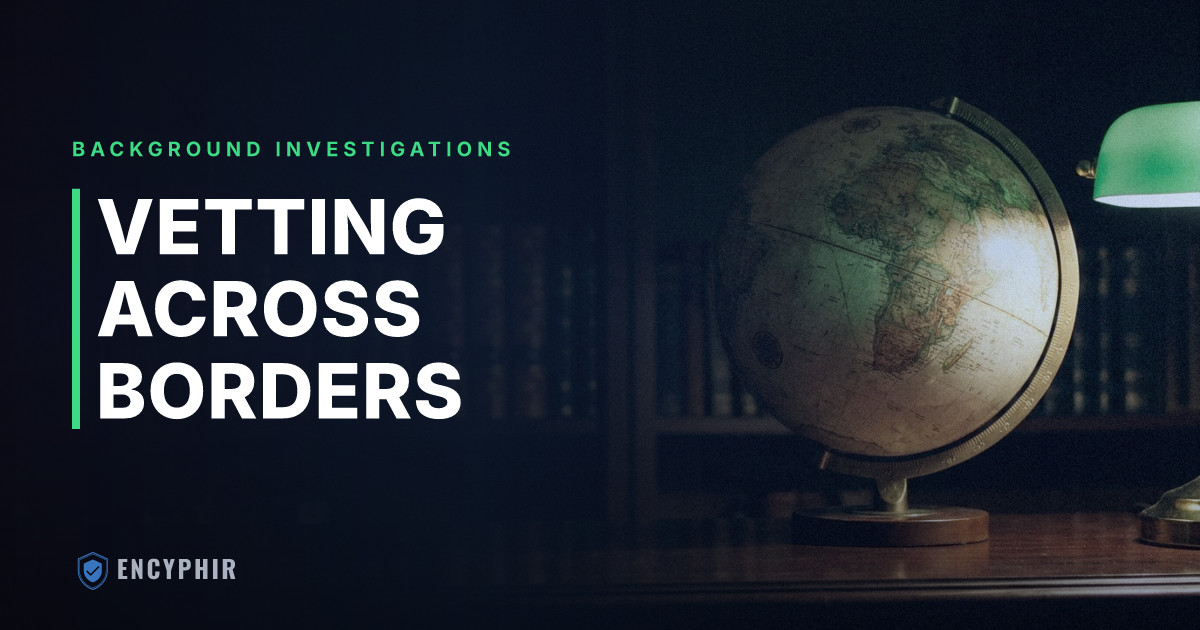
In an era where talent pools, supply chains, and executive teams span continents, hiring across borders has become routine for organizations of every size. What has not become routine is the ability to verify the people behind those international resumes. A background check that takes three business days domestically can take three weeks or more abroad, and the obstacles are not just logistical. Privacy laws, fragmented record systems, language barriers, and inconsistent data quality all conspire to make global vetting one of the most complex tasks a risk manager will face.
For employers, investors, and legal teams, the stakes are high. A missed criminal record, an unverified credential, or an undisclosed sanction can introduce reputational, financial, and regulatory exposure that is difficult to unwind. Below, we examine the most common challenges of international background checks and outline how a disciplined investigative approach can deliver reliable results.
Why International Background Checks Are Inherently Complex
Unlike the United States, where many criminal and civil records are accessible through centralized or county-level repositories, most countries do not offer a single national database for employment screening. In some jurisdictions, criminal records can only be obtained by the candidate in person, with notarized identification, and at a specific government office. In others, records are scattered across regional courts with no digital index at all.
Layered on top of this are wide variations in:
- Data privacy laws, including the EU's GDPR, Canada's PIPEDA, and Brazil's LGPD, which restrict what can be collected, stored, and transferred.
- Consent requirements, which often must be obtained in the candidate's native language and tailored to local regulations.
- Educational and professional verification standards, which differ dramatically between countries with formal accreditation bodies and those without.
- Sanctions and watchlist coverage, which requires access to global databases that go well beyond OFAC.
A screening program designed for U.S. hiring will almost always fall short when applied to international candidates without significant adaptation.
Common Pitfalls Employers Encounter
Many organizations underestimate how much can go wrong. We routinely see clients come to us after relying on automated, low-cost international screening tools that return either incomplete results or false confidence. Common pitfalls include:
- Assuming "global" databases are comprehensive. Most aggregator databases pull from a limited set of public sources and miss country-specific records entirely.
- Failing to localize consent forms. A consent form valid in California may be unenforceable, or even illegal, in Germany or Japan.
- Overlooking name variations and transliteration issues. Names rendered differently in Cyrillic, Arabic, or Mandarin scripts can produce false negatives or false positives without expert review.
- Ignoring reputational and media checks. In many regions, adverse information surfaces in local press, regulatory filings, or court dockets long before it reaches any database.
These gaps are particularly dangerous in executive hiring, mergers and acquisitions, and cross-border partnerships, where a single undisclosed issue can derail a transaction. For these higher-stakes engagements, integrated due diligence is essential, not a checkbox-style screen.
Practical Solutions That Produce Reliable Results
Effective international background investigations require a hybrid approach: technology to scale, combined with human investigators who understand local laws, languages, and record systems. At Encyphir, our background investigations practice is built around several core principles:
- In-country resources. We engage vetted local researchers who can physically retrieve court records, validate credentials with universities, and confirm employment with former employers in the appropriate language.
- Jurisdiction-specific scoping. Before launching a check, we map the candidate's history to the countries where verifiable records actually exist, setting realistic expectations on timelines and deliverables.
- Compliance-first consent. Every engagement begins with localized, legally compliant disclosure and authorization documents.
- Source-level verification. We rely on primary sources whenever possible, treating database hits as leads to confirm rather than conclusions to report.
- Adverse media and reputational analysis. We supplement records-based checks with multilingual media review and, where warranted, discreet inquiries.
For sensitive executive placements or transactional matters, this work often dovetails with broader executive and corporate inquiries, where verifying a candidate's history is only the first layer of risk assessment.
Building a Defensible International Screening Program
A strong program is not just about catching bad actors. It is about creating a defensible, repeatable process that protects the organization if a hiring decision is ever questioned. That means documented procedures, consistent application across candidates, audit trails, and clear escalation paths for adverse findings. It also means recognizing that international screening is a specialty, not a commodity. The cheapest provider is rarely the one that will stand behind its findings when challenged in court or by a regulator.
Move Forward With Confidence
Global hiring and cross-border deal-making will only continue to accelerate. Organizations that treat international background checks as a strategic function, rather than an administrative one, will be better positioned to manage risk, protect their reputations, and make confident decisions.
If your organization is hiring internationally, evaluating a foreign partner, or navigating a cross-border transaction, the team at Encyphir can help you design a screening program that is rigorous, compliant, and defensible. Contact us today to discuss your needs and learn how our investigators deliver clarity where others deliver guesswork.