One-Party vs. Two-Party Consent: What Every Business Needs to Know About Recording Laws
 May 1, 2026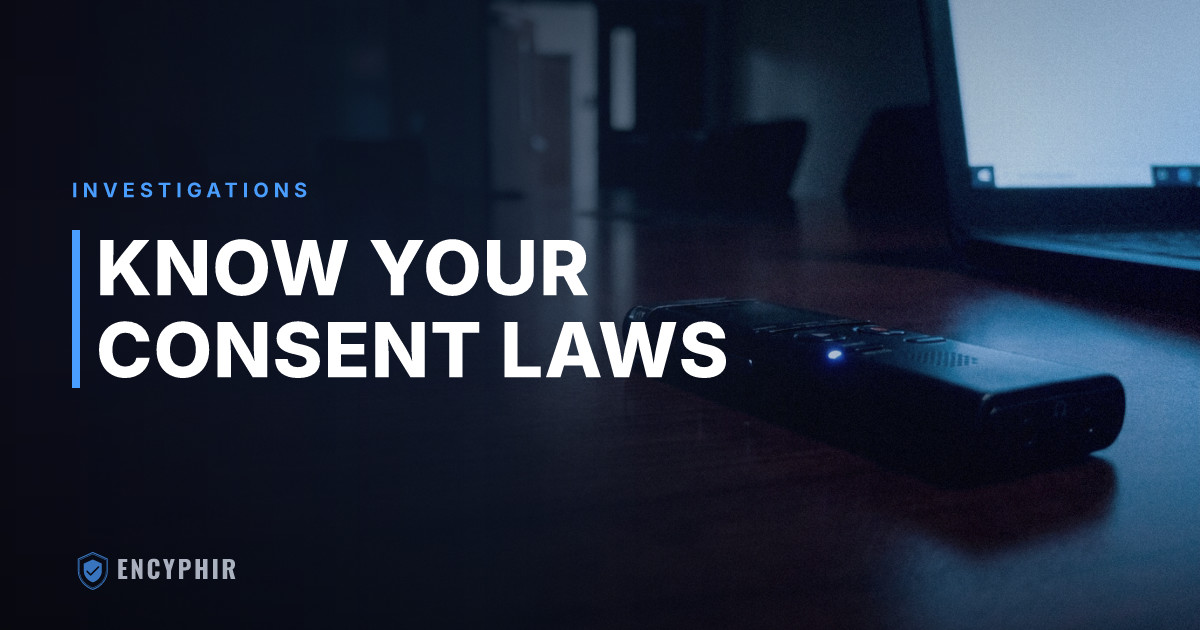
Recording a phone call, capturing a conversation during a workplace investigation, or conducting lawful surveillance all hinge on one critical legal concept: consent. Whether your organization operates in one state or across many, understanding the difference between one-party and two-party consent laws is not optional. It is essential. Getting it wrong can expose your company to criminal liability, civil lawsuits, and the exclusion of critical evidence when you need it most.
At Encyphir, we regularly guide corporate clients, legal teams, and HR departments through the complexities of lawful evidence collection. This post breaks down what one-party and two-party consent mean in practice, where the laws differ, and how your organization can stay compliant while still protecting its interests.
What Is One-Party Consent?
Under one-party consent laws, only one participant in a conversation needs to consent to the recording. In practical terms, this means that if you are part of a conversation, you can legally record it without notifying the other party. A private investigator working on your behalf may also record a conversation they are directly participating in, provided they are operating in a one-party consent jurisdiction.
The federal standard in the United States, established under the Electronic Communications Privacy Act (18 U.S.C. § 2511), follows the one-party consent model. The majority of states also follow this framework, making it the more common standard nationwide.
For businesses, one-party consent is frequently relevant in scenarios such as:
- An employee recording a conversation with a colleague suspected of misconduct
- A licensed investigator conducting an authorized corporate investigation that involves recorded interviews
- A compliance officer documenting verbal admissions during an internal review
However, "one-party" does not mean "no-party." You cannot simply place a recording device in a room and walk away. At least one person who is actively part of the conversation must consent.
What Is Two-Party (All-Party) Consent?
Two-party consent laws, sometimes referred to as all-party consent laws, require every participant in a conversation to agree to the recording. If even one person is unaware that the conversation is being captured, the recording may be illegal, and any evidence derived from it could be inadmissible.
States with two-party consent laws include California, Florida, Illinois, Pennsylvania, Washington, Maryland, and several others. The specifics vary from state to state. Some states apply the standard only to conversations where there is a reasonable expectation of privacy, while others interpret the requirement more broadly.
For companies conducting multi-state operations, this patchwork of laws creates real risk. A recording that is perfectly lawful in Texas could result in criminal charges if the other party is located in California.
Why This Matters for Corporate Investigations and Surveillance
Consent laws have a direct impact on how investigations are conducted and how evidence is gathered. When Encyphir performs surveillance operations or supports digital evidence collection, our team accounts for the applicable consent laws at every stage. Failing to do so can compromise an entire case.
Consider these common scenarios:
- Workplace misconduct investigations: If your company is investigating fraud, harassment, or policy violations, recorded statements may be a key piece of evidence. The legality of those recordings depends entirely on where the conversation takes place and which consent standard applies.
- Litigation support: Attorneys building a case need evidence that will hold up in court. Recordings obtained in violation of consent laws are not just inadmissible; they can generate countersuits and sanctions. Our work with law firms includes ensuring that all evidence collection methods meet the legal threshold for admissibility.
- Interstate operations: A company headquartered in a one-party state investigating an employee in a two-party state must follow the stricter standard. The general rule of thumb is to default to the more restrictive law when there is any jurisdictional overlap.
Best Practices for Staying Compliant
Navigating consent laws does not have to be paralyzing, but it does require intentionality. Here are several best practices Encyphir recommends to every client:
- Know your jurisdiction. Before any recording takes place, confirm the consent requirements in every state where participants are located. When in doubt, apply the stricter two-party standard.
- Document consent clearly. If you are operating under a two-party consent framework, obtain and record explicit verbal or written consent before the conversation begins.
- Train your team. Ensure that HR professionals, compliance officers, and managers understand the basics of recording laws. A well-intentioned but uninformed employee can create significant legal exposure.
- Work with licensed professionals. Investigations that involve recordings, digital evidence, or surveillance should be handled by experienced, licensed investigators who understand the legal landscape.
- Consult legal counsel. Consent laws intersect with federal wiretapping statutes, state privacy laws, and industry regulations. Legal review should be part of every investigative plan.
Protect Your Organization the Right Way
Recording laws exist to protect privacy, but they also create a minefield for organizations that need to gather evidence quickly and lawfully. The difference between one-party and two-party consent can determine whether your evidence wins a case or becomes the basis for a lawsuit against your company.
Encyphir Risk Management helps businesses, legal teams, and institutions navigate these complexities every day. From planning lawful surveillance to conducting compliant corporate investigations, our licensed team ensures that every step of the process is defensible.
If your organization is facing a situation that may require recorded evidence, surveillance, or a formal investigation, do not risk doing it alone. Contact Encyphir today to discuss how we can help you gather the evidence you need while staying fully within the law.