Recorded vs. Unrecorded Interviews in Investigations: Weighing the Pros and Cons
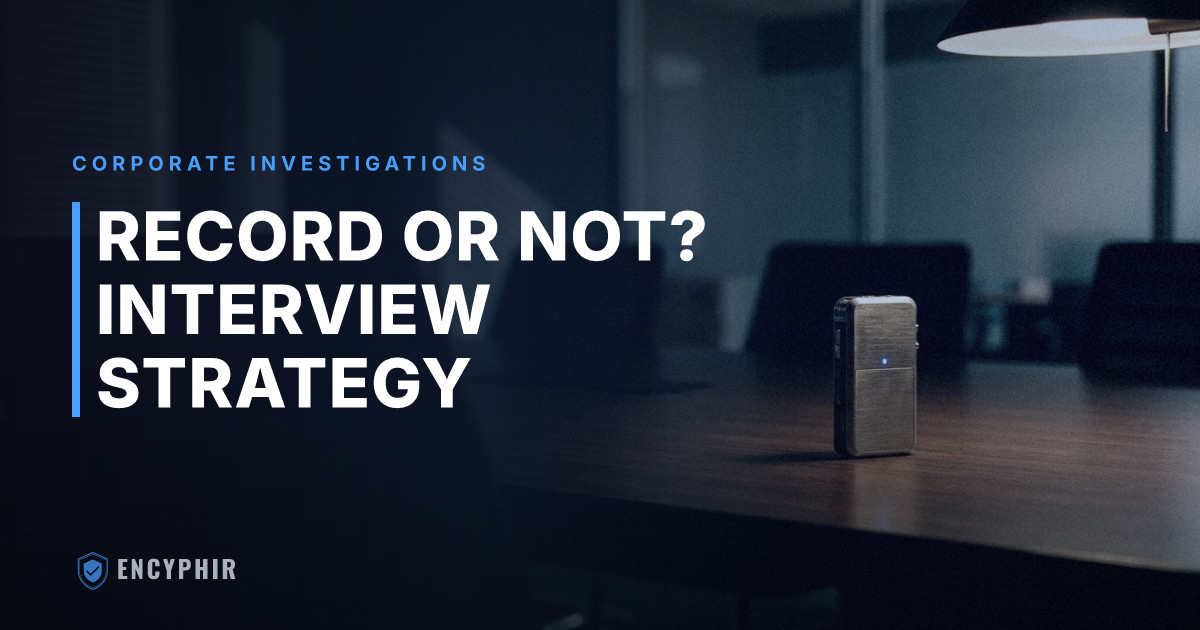
Interviews are the backbone of nearly every serious investigation. Whether the matter involves suspected fraud, workplace harassment, executive misconduct, or a broader corporate compliance concern, the way a witness or subject is questioned, and how that conversation is documented, often determines the strength of the entire case. One of the most consequential decisions an investigator makes long before the first question is asked is whether to record the interview or rely on written notes alone.
At Encyphir Risk Management, our licensed investigators weigh this decision carefully on every engagement. The right approach depends on jurisdiction, corporate policy, the nature of the allegations, and the ultimate audience for the findings, whether that be internal leadership, outside counsel, regulators, or a courtroom. Below, we break down the practical trade-offs so business leaders and legal teams can make informed choices.
The Case for Recorded Interviews
Recorded interviews, whether audio or video, offer an unmatched level of accuracy. Every word, pause, and inflection is captured exactly as spoken, eliminating disputes over what a witness said or meant. In corporate investigations involving executive misconduct or fraud, this fidelity can be invaluable when findings are later challenged or scrutinized by outside counsel.
Key advantages include:
- Verbatim accuracy. There is no reliance on memory or shorthand notes. The record speaks for itself.
- Credibility of findings. When investigators present conclusions to a board, a jury, or regulators, a recording removes ambiguity about what was actually said.
- Protection against retraction. Subjects sometimes claim they were misquoted or coerced. A recording provides objective evidence to the contrary.
- Better analysis. Recordings allow investigators to review tone, hesitation, and nonverbal cues that may reveal deception or discomfort during subsequent review.
- Efficient collaboration. Legal teams and forensic analysts can review the source material directly rather than relying on secondhand summaries.
For investigations that may lead to litigation, termination, or referral to law enforcement, recorded interviews often become critical evidence.
The Drawbacks of Recording
Despite the benefits, recording is not always the right choice. Legal considerations vary significantly by jurisdiction. Some states require all parties to consent to a recording, while others allow single-party consent. Recording without proper consent can expose the organization to civil liability and can render the evidence inadmissible.
Other considerations include:
- Chilled candor. Subjects and witnesses often become guarded when they know they are being recorded. Valuable information may go unspoken.
- Discovery exposure. Recordings are discoverable in litigation. Every hesitation, misstatement, or off-topic comment becomes part of the record.
- Storage and chain of custody. Recordings must be securely stored, catalogd, and preserved. Mishandling can compromise both the evidence and the investigation.
- Perception of adversarial intent. In sensitive internal matters, a recorder on the table can transform a fact-finding conversation into what feels like an interrogation.
For these reasons, some investigators, particularly those working closely with law firms and outside counsel, deliberately choose not to record certain preliminary interviews.
The Case for Unrecorded Interviews
Unrecorded interviews, documented through detailed contemporaneous notes and a follow-up written summary, remain a legitimate and widely used investigative tool. They tend to encourage more open conversation, allow the investigator to shape the tone of the discussion, and produce a work product that can be structured for the specific needs of the client.
Benefits include:
- Greater openness from subjects. Witnesses often speak more freely when there is no microphone present.
- Flexible documentation. Investigators can prepare summaries emphasizing the facts most relevant to the inquiry.
- Reduced legal exposure. With no recording, there is less risk of running afoul of consent laws or creating discoverable material that includes irrelevant tangents.
- Faster deployment. No equipment, no consent forms, and no post-interview transcription workload.
The trade-off, of course, is that the investigator's notes and credibility become the sole record of what was said. This places a premium on hiring experienced, well-trained professionals whose documentation will hold up under scrutiny.
Choosing the Right Approach for Your Investigation
There is no universal answer. The decision should be guided by the type of investigation, the applicable legal framework, the sensitivity of the subject matter, and the anticipated end use of the findings. High-stakes matters such as digital forensics investigations and regulatory inquiries often benefit from recording. Internal cultural assessments or early-stage fact-finding may be better served by unrecorded conversations.
A seasoned investigator will also consider hybrid approaches, such as recording only key subject interviews while keeping witness conversations informal, or using signed written statements to memorialize critical admissions.
Partner With Experienced Investigators
Interview strategy is not a checkbox. It is a judgment call that can make or break an investigation. Encyphir Risk Management's licensed investigators bring decades of experience conducting interviews that stand up to legal, regulatory, and boardroom scrutiny. If your organization is facing a sensitive internal matter or preparing for a complex inquiry, contact Encyphir today to discuss how our team can help you protect your interests and uncover the truth.