Spatial Awareness and Surveillance: How Observation Skills Drive Effective Investigations
 April 19, 2026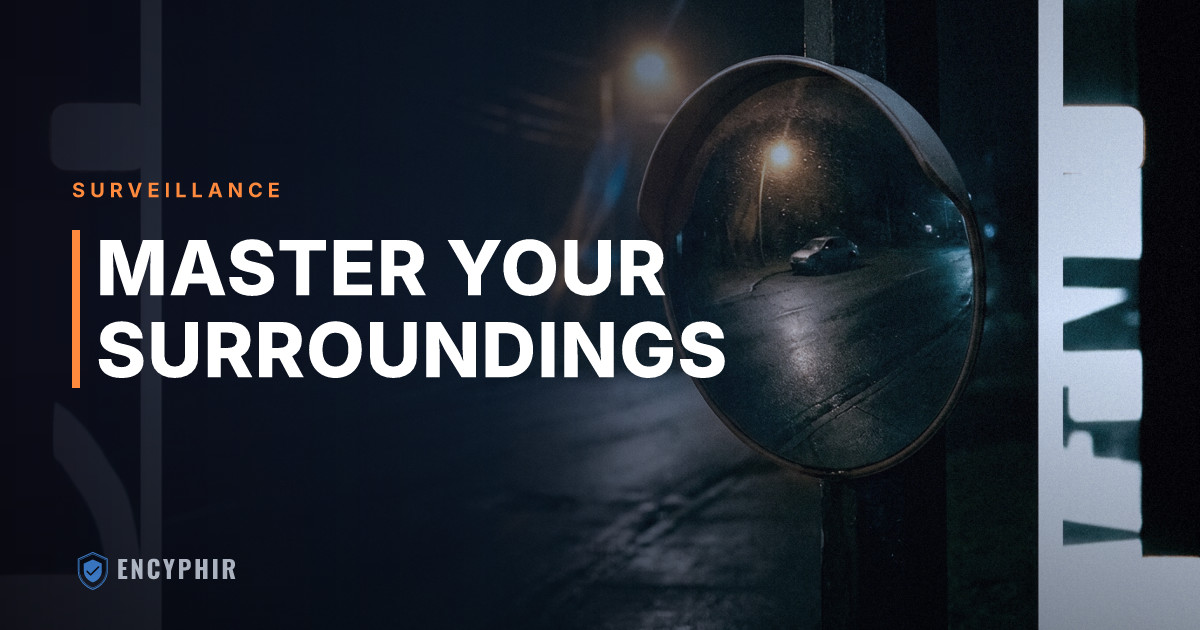
Few skills in professional investigations are as critical, or as underestimated, as spatial awareness. The ability to read, interpret, and respond to your physical environment can decide whether an operation succeeds or gets compromised. This applies to mobile surveillance, security assessments of corporate facilities, and monitoring foot traffic at public events.
At Encyphir Risk Management, spatial awareness is not a buzzword. It is a foundational skill that our investigators develop, refine, and rely on every day. This post breaks down what spatial awareness means in professional surveillance and why it matters for the businesses and individuals who depend on accurate, discreet intelligence.
What Is Spatial Awareness in Surveillance?
Spatial awareness is the ability to understand and interact with your surroundings in real time. In surveillance, this means keeping a constant mental map of where you are, where your subject is, and where exposures exist. It also means tracking how lighting, crowd density, and traffic patterns affect your operation.
A skilled surveillance operative is not simply following someone. They process dozens of variables at once, including:
- The layout of a parking lot
- The timing of traffic signals
- The positioning of security cameras
- Alternate exit routes from a building
- The behavior of bystanders who could interfere with the operation
This level of environmental processing requires training, experience, and discipline.
Why Spatial Awareness Matters for Effective Surveillance
Poor spatial awareness is one of the fastest ways to burn a surveillance operation. An investigator who misses a dead-end street, sits too close to a subject in a sparse area, or ignores reflective surfaces puts the entire case at risk.
Strong spatial awareness lets investigators anticipate a subject's movements, hold the right distance, and adapt to changing conditions. It allows for smooth transitions between mobile and stationary surveillance. It also reduces the risk of detection. Our professional surveillance services are built on these principles, ensuring every operation runs with precision and discretion.
The stakes are high for corporate clients. The quality of surveillance directly affects the reliability and admissibility of evidence. This holds true whether you are investigating employee misconduct, verifying workers' compensation claims, or gathering evidence for litigation.
Key Elements of Spatial Awareness in the Field
Several core elements define strong spatial awareness during surveillance operations:
Environmental scanning. Experienced investigators run thorough area assessments before an operation begins. They study satellite imagery, map ingress and egress points, identify choke points, and note features that could aid or hinder observation. This pre-operational planning is a hallmark of professional risk management.
Peripheral monitoring. Effective surveillance requires constant peripheral awareness. Investigators must watch the subject, the behavior of nearby people, approaching vehicles, and shifts in the environment that could signal a problem.
Adaptive positioning. Static positions become liabilities over time. Skilled operatives know when and how to reposition without drawing attention. They use natural cover and blending techniques to keep visual contact while staying inconspicuous.
Communication and coordination. In team surveillance, spatial awareness extends to knowing the exact positions of teammates. Operatives coordinate handoffs smoothly and ensure full coverage without overlap or gaps.
How Spatial Awareness Supports Broader Security Goals
Spatial awareness is not limited to surveillance operations. It also plays a vital role in security consulting, where our team evaluates physical vulnerabilities in corporate environments, retail locations, and other facilities. Effective security protocols depend on knowing how people move through a space, where blind spots exist, and how access points can be exploited.
Spatial awareness training can also protect executives and organizations facing threats. Teaching key personnel to recognize when they are being followed, vary their routines, and read environmental cues can significantly reduce their exposure to risk.
The Cognitive Foundations of Situational Awareness
Spatial awareness is ultimately a cognitive discipline. Top investigators train themselves to run what security professionals call the observe, orient, decide, and act loop. This mental model pushes the operative to:
- Continuously observe the environment
- Orient new information against prior knowledge of the area and subject
- Decide on a course of action
- Execute without hesitation
The faster and more accurately an investigator moves through this loop, the less likely they are to be caught flat-footed.
Seasoned investigators stand apart because they can filter noise from signal. Hundreds of people move in countless directions in a busy shopping district. An untrained eye sees chaos. A trained eye sees baselines: the typical pace of foot traffic, the usual flow of vehicles, the ordinary behavior of patrons in a coffee shop.
When something breaks that baseline, the trained eye notices. That might be a subject pausing to check a reflection, a countersurveillance operative scanning the same crowd, or a bystander lingering near an investigator's vehicle. This ability to detect anomalies turns passive observation into actionable intelligence. We emphasize this skill throughout our security and safety training programs.
Applying Spatial Awareness Across Case Types
Different investigations demand different applications of spatial awareness. Experienced operatives know how to recalibrate based on the case.
In domestic matters such as infidelity investigations, the environment is often intimate and low-traffic. A subject may travel to a quiet residential area, a private club, or a secluded parking lot. An unfamiliar vehicle stands out immediately. The investigator must rely on long-distance observation, careful vehicle selection, and a clear sense of when to hold back. Misjudging the density of a neighborhood can turn a routine surveillance into a confrontation.
Corporate and litigation-support work presents different spatial challenges. Surveillance of a workers' compensation claimant may require hours of covert observation outside a home, then rapid repositioning when the subject leaves. Courts review how footage is obtained, so the investigator must balance aggressive pursuit of evidence against the legal and ethical limits of public observation. For clients pursuing executive misconduct investigations, surveillance may occur in upscale business districts. The subject is often accompanied by colleagues or assistants trained to notice unusual patterns.
School-based investigations, such as out-of-district residency cases, often involve extended observation of residences at early morning and late evening hours. Investigators must work in neighborhoods where a parked vehicle attracts attention from residents, homeowner associations, or local law enforcement. Knowing the local terrain, including commuter patterns and alternate routes, is essential to documenting conduct without compromising the inquiry.
Technology, Terrain, and the Limits of Tools
Modern surveillance uses a growing suite of technical tools, but each carries its own spatial considerations. GPS trackers provide location data. They do not tell an investigator whether a subject is alone, who they are meeting, or what they are doing inside a building. Drones expand the field of view, but they bring airspace rules, noise signatures, and visibility concerns into the operational plan. Long-lens photography captures critical evidence, but it demands sightlines, proper cover, and awareness of how glass, mirrors, and polished vehicle surfaces can give away the operator's position.
Every piece of technology interacts with the physical environment in predictable and unpredictable ways. A skilled investigator treats tools as extensions of spatial awareness, not substitutes for it. When digital records need to corroborate field observations, our digital forensics team works alongside field operatives. Together, they make sure physical surveillance and electronic evidence tell a consistent, legally defensible story.
Building Spatial Awareness Within Client Organizations
Many corporate and institutional clients benefit from developing in-house situational awareness. This is especially true for executives, security staff, and personnel who travel frequently or handle sensitive matters. Principals who can spot surveillance against themselves, identify vulnerabilities in their routines, and report concerns clearly to a protective team are much harder targets.
The same applies to law firms handling sensitive litigation, school administrators managing contentious matters, and family offices coordinating household staff. We regularly advise corporate clients on how to fold spatial awareness into their broader risk management posture. That work combines staff training with professional investigative support as needed.
Investing in Professional Surveillance
Amateur surveillance efforts often fail because they lack the foundational skill sets that professional investigators bring. This is true whether the work is done by untrained internal staff or cut-rate service providers. Spatial awareness is one of those skill sets, and technology alone cannot replace it. GPS trackers, cameras, and digital tools are important force multipliers, but they are only as effective as the operators behind them.
The quality of the investigator matters when your organization needs reliable, court-ready intelligence through expert surveillance. At Encyphir Risk Management, our team combines advanced technology with seasoned field skills to deliver results you can trust.
Ready to discuss a surveillance need or security concern? Our training team also delivers spatial-awareness and executive-protection training for principals, assistants, and household staff when the skill needs to live inside the client rather than only within the investigative team. Contact Encyphir Risk Management today for a confidential consultation. Our licensed investigators are ready to help you protect your interests with professionalism and precision.