Is a Screenshot Admissible Evidence in California? What Courts Actually Require
 November 10, 2026
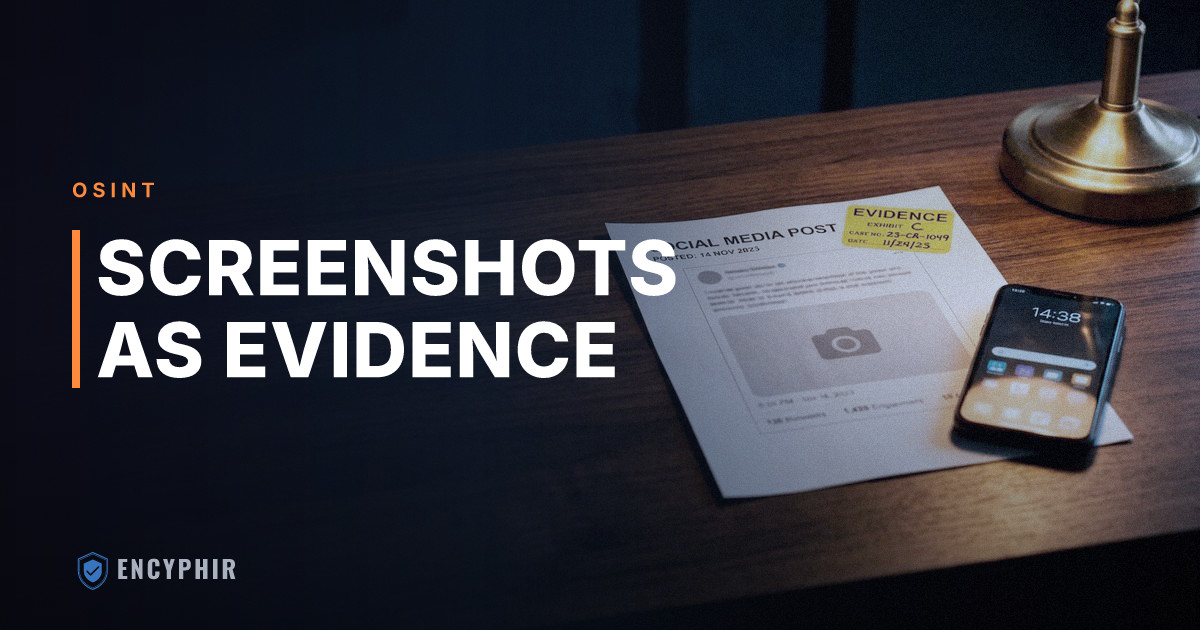
Every family law attorney, insurance adjuster, and employment lawyer in California has been handed a screenshot by a client who is certain it proves the case. Sometimes it does. More often it starts an argument about whether the post was real, whether it was edited, who actually wrote it, and when. Whether a screenshot survives that argument depends on what was done when it was captured, and that is the part most people get wrong.
What California Requires Before a Screenshot Comes In
California's Evidence Code treats a screenshot like any other writing. Under sections 1400 and 1401, a writing must be authenticated before it is admitted, which means the party offering it has to produce evidence sufficient to support a finding that it is what they say it is. For a social media post, that means two things: that the post existed in the form shown, and that the person it is attributed to is the one who posted it.
The California Court of Appeal has addressed social media authentication directly. In People v. Valdez (2011), the court admitted a MySpace page after a gang expert testified to its contents and the circumstances tying it to the defendant, holding that authentication can rest on circumstantial evidence such as the account's name, photographs, and personal details that only the purported author would know. In In re K.B. (2015), Facebook messages were admitted on similar reasoning. The through-line in these cases is that the court does not demand a confession from the platform; it demands enough surrounding evidence that a reasonable fact-finder could conclude the post is genuine.
That standard cuts both ways. A screenshot with no URL, no date, no account identifiers, and no explanation of how it was taken gives the court nothing to work with, and opposing counsel will say so.
Why Screenshots Taken by a Party Are the Weakest Form
The problem is not that screenshots are inherently unreliable. The problem is that a screenshot taken by the person who benefits from it, with no record of when or how, is easy to attack. Three objections come up again and again.
The first is alteration. Image editing is trivial, and a screenshot carries no internal proof that it was not changed. The second is attribution. A post under someone's name is not the same as proof that the person wrote it; accounts are shared, spoofed, and hacked. The third is context. A single message cropped from a conversation can mean the opposite of what the full thread shows, and courts know it.
None of these objections is fatal on its own, but each one shifts the burden back onto the party offering the evidence, and a party who cannot answer them loses the exhibit or watches its weight collapse.
What Makes Social Media Evidence Hold Up
The difference between a screenshot that gets excluded and one that gets admitted is documentation of the capture. The practices that courts and opposing experts look for are consistent.
Capture the full page, including the URL, the account handle, the date and time the content was posted, and the date and time it was captured. Preserve the content in a form that cannot be silently altered, which in practice means a forensic capture with a cryptographic hash computed at the time of collection. Keep a collection log that records who captured the content, with what tool, from what account, and in what order. Corroborate attribution with the surrounding evidence the Valdez line of cases relies on: profile photographs, personal details, linked accounts, and other posts in the same voice. And have a witness who can explain all of it on the stand.
That last point is the one people underestimate. Evidence does not authenticate itself. Someone has to testify to how it was gathered, and the testimony of a licensed investigator who followed a documented method carries weight that a party's own account of taking a screenshot does not.
When to Stop Taking Screenshots and Call an Investigator
If a post is incidental, a screenshot with a note of the date and URL may be all the case needs. If the case turns on the content, treat it the way you would treat any other piece of critical evidence. Do not rely on your own capture. Do not message the subject, send a friend request, or ask a mutual acquaintance to pull content from a private account, because evidence obtained by deception is excluded and exposes you. Have the public content preserved by someone who can authenticate it, and do it quickly, because deleted posts are only recoverable if they were captured first.
Encyphir's social media investigations are built for exactly this. Public-source collection only, hash-verified captures with a chain-of-custody log, and investigators who testify to the method in California, Florida, and federal courts. For the broader question of what an investigator can and cannot access, see Can a PI Access Social Media Without Permission?
Frequently asked questions
Can I use a screenshot of a text message or post in a California family court case?
Yes, if you can authenticate it. Family courts routinely see screenshots, and routinely hear the other side say the message was edited or never sent. Keep the original on the device, note when and how you captured it, and preserve the surrounding conversation, not just the one message. For anything the case turns on, have the content preserved by a licensed investigator who can testify to the capture.
What makes a social media screenshot inadmissible?
The common reasons are no proof of who posted it, no proof of when, visible cropping or editing, a missing URL, and no witness who can explain how it was captured. Hearsay objections also come up, though a party's own statements on social media are generally admissible against them.
How does a private investigator make social media evidence admissible?
By capturing it with the URL, date, time, and a cryptographic hash, logging the method in a collection record, preserving the page so it can be produced after deletion, and testifying to how it was collected. That turns a picture of a post into evidence a court can rely on.