What Is Forensic Document Examination? How Questioned Document Examiners Work
 November 11, 2026
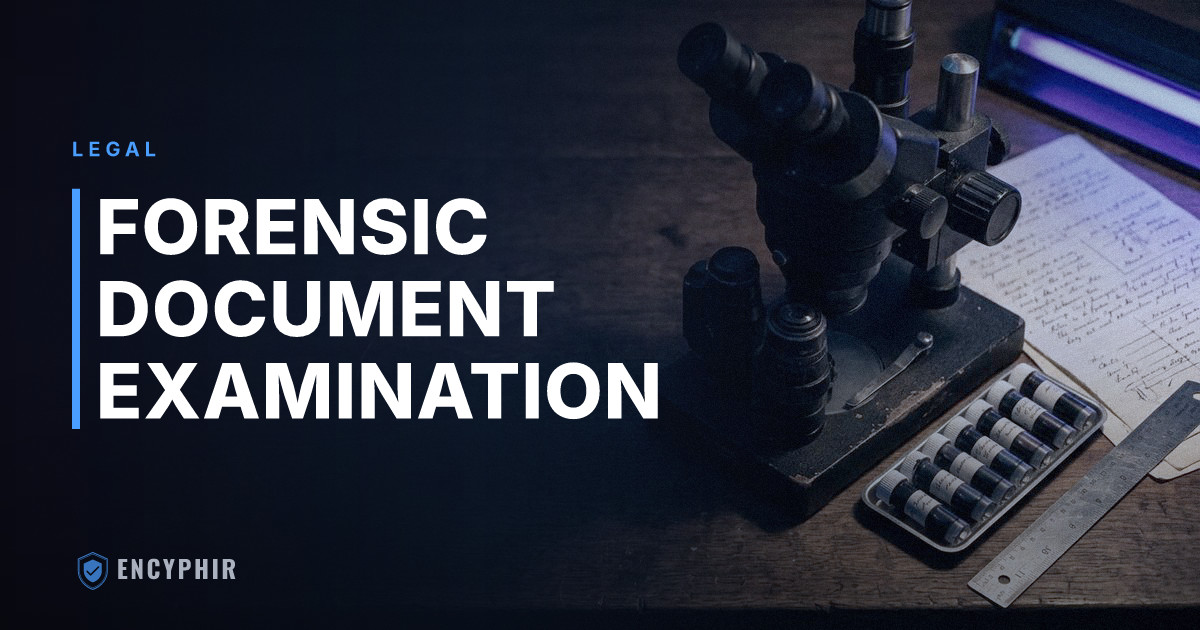
When a signature on a contract is denied, a will appears that no one expected, or a check comes back with a different amount than it left with, the dispute comes down to a physical object: the document. Forensic document examination is the discipline that answers questions about that object. This is what it is, what it can and cannot establish, and how examiners do the work.
The Questions an Examiner Answers
Forensic document examination, historically called questioned document examination, addresses a small number of recurring questions. Who wrote this? Is this signature genuine? Was this document changed after it was signed? Were these pages produced together, or was one substituted? Was this document really made on the date it bears? What was written on the page that used to be on top of this one? Which of two entries on a page was written first?
Each question has an established method behind it, and the methods are what make the resulting opinion evidence rather than guesswork.
Handwriting and Signature Comparison
The best-known part of the discipline is comparing questioned handwriting or a questioned signature with known exemplars from the person it is attributed to. Handwriting is a practiced, largely unconscious motor habit, and each writer develops a combination of features, letter forms, proportions, slant, spacing, connecting strokes, pressure patterns, and beginning and ending strokes, that is individual in combination even when no single feature is unique.
The examiner studies the questioned writing and the exemplars under magnification and oblique light, cataloging those features and their natural range of variation, and then asks whether the questioned writing falls within the known writer's range or shows the signs of simulation, tracing, or a different hand. Forgeries tend to reproduce the visible shape of letters and miss the unconscious habits, and to show the drawn, hesitant line quality of someone copying rather than writing. The result is an opinion on a recognized scale from identification to elimination, with inconclusive in the middle when the evidence does not support a conclusion.
Alterations, Additions, and Substituted Pages
Documents are changed after signing more often than people expect: a figure on a check, a date on a contract, a beneficiary on a form, a page in a multi-page agreement. The examiner looks for the physical traces. Under infrared and ultraviolet examination and with a video spectral comparator, inks that look identical to the eye often respond differently, revealing that a word or number was added with a different pen. Erasures and chemical obliterations disturb the paper's surface and fluorescence. Substituted pages show differences in paper, toner, printer characteristics, margins, font rendering, staple holes, and folding that mark them as having been produced separately from the rest.
Ink, Paper, and Printing Processes
Whether a document could have been produced on its claimed date is a question of materials. Inks, papers, toners, and printing technologies have histories, and a document bearing a date that predates the ink it was written in, or the printer that produced it, is not what it claims to be. The examiner characterizes the materials and the production process and compares them with what was available and in use at the relevant time.
Indented Writing and Sequence of Entries
Writing on a sheet of paper leaves impressions on the sheets beneath it. Electrostatic detection recovers those impressions even when they are invisible, which can reveal what was written on a page that is now missing, or show that a document was signed on top of another document it should never have been near. Where two entries on a page cross or overlap, microscopic examination of the intersection can often establish which was written first, which matters when the order of a signature and the text above it is in dispute.
How Findings Are Reported and Used
A competent examination is documented so that another qualified examiner could review the same evidence and follow the same reasoning. The report states the question, the material examined, the method, the observations with photographic exhibits, and the opinion on the confidence scale, including the limits of what the evidence supports. The examiner is then available to testify at deposition and trial, and the report's exhibits become the demonstratives a judge or jury sees.
Examinations are strongest on original documents. Copies lose line quality, pressure, indented writing, and ink differences, and while a copy can support a preliminary opinion and sometimes shows an obvious problem, the original is usually necessary for a conclusion a court can rely on. Obtaining it through discovery or a court order is often the first step counsel takes.
Encyphir provides forensic document examination for probate, trust, family law, and civil litigators, insurers, businesses, and individuals, and pairs it with the background and field investigation that forgery and fraud cases usually require. For the specific case of a contested will, see How to Prove a Signature Was Forged on a Will or Trust.
Frequently asked questions
What is the difference between a forensic document examiner and a handwriting analyst?
Graphology, often marketed as handwriting analysis, claims to read personality from handwriting and is not a forensic discipline. Forensic document examination compares physical evidence to answer specific questions of authorship and authenticity using methods, confidence scales, and documentation that courts recognize.
Is forensic document examination admissible in court?
Yes. Questioned document examination is a long-established forensic discipline, and opinions from a qualified examiner are admitted as expert evidence in California, Florida, and federal courts, subject to the usual expert qualification and reliability standards.
What kinds of documents do examiners look at?
Wills, trusts, deeds, contracts, guaranties, checks, promissory notes, invoices, medical and employment records, anonymous letters, and any other document where who wrote it, whether it was changed, or when it was made is in dispute.