
Forensic Document Examination
Questioned Documents, Examined. Opinions That Hold Up.
Signature and handwriting comparison, forgery and alteration detection, and ink, paper, and printing analysis for wills, trusts, deeds, contracts, and checks in dispute. Reports and testimony prepared for California, Florida, and federal courts.
- Signatures
- Handwriting and Forgery Comparison
- Alterations
- Infrared and UV Detection
- Ink and Paper
- Dating and Process Analysis
- Court-Ready
- Expert Reports and Testimony
What a Forensic Document Examiner Determines
A document that decides who inherits, who owes, or who signed cannot be taken at face value when someone says it is not genuine. Forensic document examination answers the specific questions a court needs answered: who wrote it, whether it was changed, and whether it was produced when and how it claims.
Signature and handwriting comparison
Side-by-side examination of a questioned signature or handwriting against known exemplars to determine whether the same person wrote both. Covers simulated and traced forgeries, disguised writing, and the genuine-but-unusual signature that gets challenged in a will or deed contest.Altered, added, and substituted pages
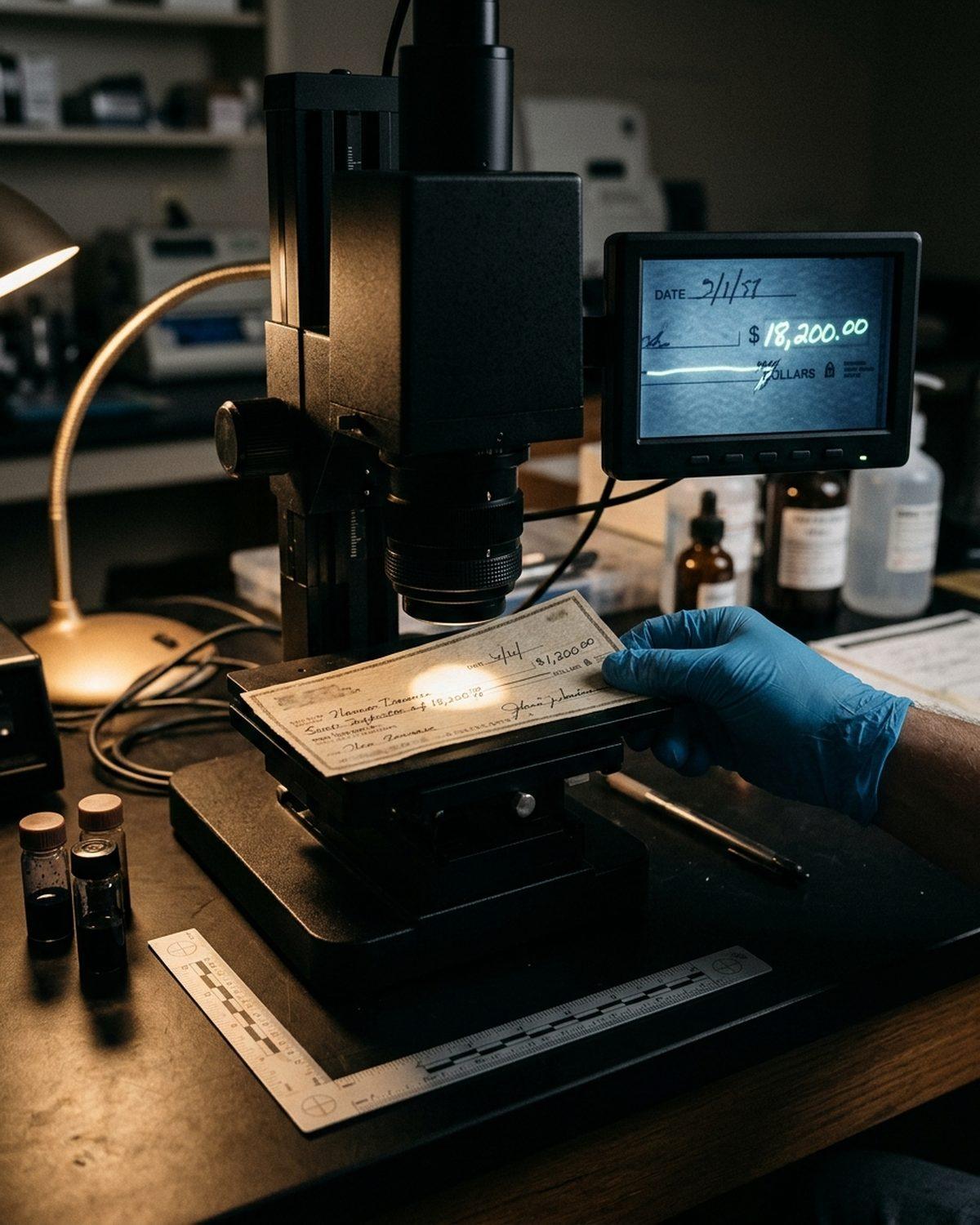
Detecting changes made after a document was signed: added words or figures, substituted pages in a contract or trust, altered dates and amounts on checks and invoices, and erasures or obliterations recovered under infrared and ultraviolet examination.Ink, paper, and printing process analysis
Determining whether a document was produced with the inks, paper, toner, and printers consistent with its claimed date and origin, and whether a multi-page document was printed and assembled at one time.Indented writing and sequence of entries
Recovering impressions left on underlying pages with electrostatic detection, and establishing which entry on a page was written first when a sequence of writing or a line crossing is in dispute.Wills, trusts, deeds, and contracts
Examination of estate planning and real property documents in probate and trust litigation, including signature authenticity, page substitution, and whether a document was executed when and where it claims.Check, loan, and business document fraud
Forged endorsements, altered checks, fabricated invoices and receipts, and employment or insurance records in dispute, examined and reported for carriers, employers, and counsel.
How the Examination Is Done
The value of an opinion is in the method behind it. Every examination is documented so another qualified examiner could review the same evidence and follow the same reasoning, which is what makes it defensible.
Method
Originals and exemplars
Examination is strongest on original documents, and we advise on how to obtain them through discovery when a copy is all you have. Known exemplars are collected from the right period and sources, because a signature changes with age, health, and circumstance.Laboratory examination
Documents are examined under magnification, oblique and transmitted light, infrared and ultraviolet imaging, video spectral comparison, and electrostatic detection, and the work is photographed and documented so it can be reviewed and reproduced.Opinions stated honestly
Findings are expressed on a recognized scale of confidence, from identification to elimination, and when the evidence does not support a conclusion we say so. An opinion that overreaches is the one that gets taken apart on cross-examination.Reports and testimony
Written reports are prepared to meet the standards for expert opinion in California and federal courts, with the demonstrative exhibits judges and juries need, and our examiners are available for deposition and trial.
Counsel, Insurers, Businesses, Families
Probate, trust, and family law attorneys
Contested wills and trusts, disputed deeds and transfers, and signatures on prenuptial, settlement, and support agreements.Civil litigators and insurers
Contract and guaranty disputes, altered business records, forged endorsements, fabricated claim documentation, and employment records in dispute.Businesses and individuals
A signature you do not recognize, a document that looks changed, or a transaction you need to authenticate before it becomes a lawsuit.
Why Encyphir?
- Forensic document examination combined with the field investigation a forgery case usually needs
- Examination documented so it can be reviewed, reproduced, and defended
- Expert reports and testimony for California, Florida, and federal courts
- Licensed investigators in California (PI 190157) and Florida (A 3600116)
Request a Free Consultation
Fill out the form and we'll reach out via your preferred contact method within 24 hours.
- Licensed & insured investigators
- All inquiries are strictly confidential
- No obligation - just answers
- Available for emergency consultations
For emergency or expedited services,
please call us directly:
(888) 965-5150
Related Reading
- What Is Forensic Document Examination?
- How to Prove a Signature Was Forged on a Will or Trust
- How Examiners Detect Altered Contracts and Substituted Pages
- Forensic Accounting in Litigation
- Legal Document Management Best Practices
- Forensic Video Analysis and Video Evidence in Court
- Business Ownership and Shell Company Investigations
- What Is Forensic Accounting? A Complete Guide
Other Services
Frequently Asked Questions
What is forensic document examination?
Forensic document examination, also called questioned document examination, is the scientific analysis of a document whose authenticity, authorship, or integrity is in dispute. An examiner compares questioned handwriting and signatures with known exemplars, detects alterations, additions, and substitutions, analyzes inks, paper, and printing processes, recovers indented writing, and establishes the sequence of entries, then reports an opinion that can be presented as expert evidence.
Can you tell whether a signature is forged?
In most cases, yes, provided we have suitable known exemplars to compare against and, ideally, the original document. Forged signatures show characteristic signs: slow, drawn line quality, pen lifts and retouching in the wrong places, tremor, blunt beginnings and endings, and a failure to reproduce the subconscious habits of the genuine writer. The examiner documents those features and states an opinion on a recognized confidence scale.
What do you need from me to examine a document?
The original questioned document whenever possible, or the best copy available while we work with counsel to obtain the original; known exemplars of the person’s signature or handwriting from around the same period, such as signed checks, contracts, cards, and government forms; and the background of the dispute so the examination is scoped to the questions that matter.
Can forensic document examination be used in court?
Yes. Questioned document examination is a long-established forensic discipline, and opinions from a qualified examiner are admitted as expert evidence in California, Florida, and federal courts. Our reports are written to those standards, with photographic exhibits that show the basis for the opinion, and our examiners testify at deposition and trial.
Do you provide forensic document examination in Orange County and Irvine?
Yes. We serve probate, trust, family law, and civil litigators across Orange County, including Irvine, Newport Beach, Santa Ana, and Anaheim, with reports prepared for the Central Justice Center, the Lamoreaux Justice Center, and federal court in Santa Ana. Documents can be examined on site, at counsel’s office, or in our laboratory under a documented chain of custody.
Can you work from a photocopy or a scanned PDF?
A copy can support a preliminary examination and often reveals obvious problems such as cut-and-paste signatures or inconsistent page formatting, but features like line quality, pen pressure, indented writing, and ink differences are lost in reproduction. We will tell you what a copy can and cannot establish, and help counsel obtain the original when the case depends on it.
How much does a forensic document examination cost?
Examinations are scoped in writing after a free consultation, based on the number of questioned documents, the exemplars available, and whether a report, deposition, or trial testimony is expected. Nothing is spent before you approve it, and if the available material cannot support a useful opinion we will tell you before you commit.
How is this different from a handwriting analyst?
Graphology claims to read personality from handwriting and is not a forensic discipline. Forensic document examination is the comparison of physical evidence to answer specific questions of authorship and authenticity, with methods, confidence scales, and documentation that courts recognize. We do the latter.
Is the Document Genuine?
Send us the questioned document and tell us what is at stake. We will tell you, free, what an examination can establish from the material you have and what it would take.